How AI Agents Can Help Small Businesses Automate Everyday Operations
Running a small business involves countless routine activities that compete for time and attention. Checking systems, gathering information, responding to requests, coordinating tasks, and following up on issues are all necessary—but they can also take time away from customers and business priorities.
Traditional automation has helped businesses streamline repetitive work for years. Now, AI agents are introducing another possibility: connecting information, tools, and workflows so that technology can assist with tasks that previously required more manual coordination.
But what does that actually mean for a small business, and where does it make practical sense to start?
Understanding the Difference Between Automation and AI Agents
Traditional automation typically follows predefined rules.
For example, when a form is submitted, a workflow might create a record, send a notification, and assign a task. These steps are predictable and work well when the process is clearly defined.
An AI agent adds another layer. With the appropriate tools and permissions, it can interpret a request, retrieve relevant information, decide which available tools to use, and coordinate multiple steps toward a defined objective.
Consider the difference:
- Traditional automation: When a monitored service becomes unavailable, send an alert.
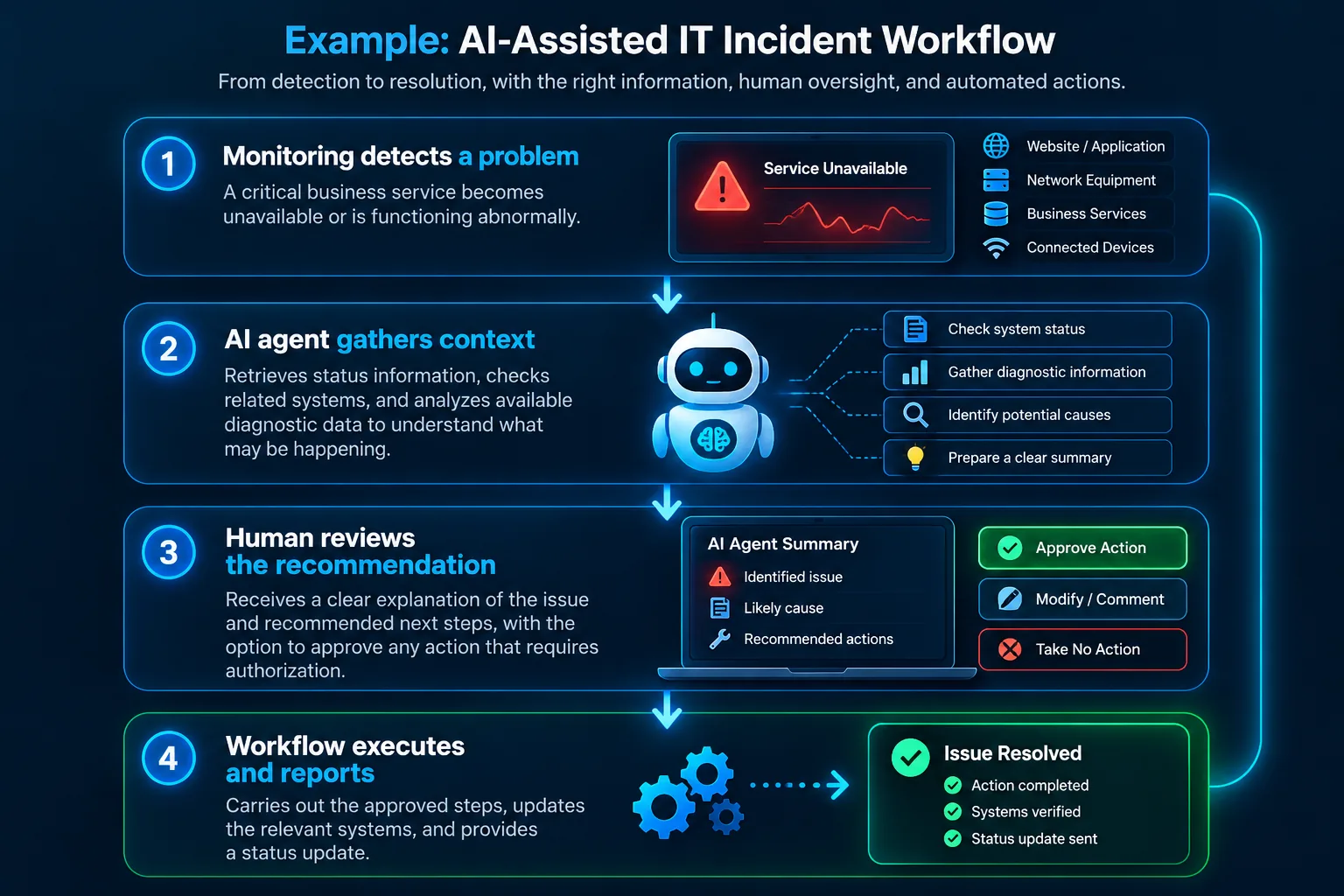
- AI-assisted workflow: When a service becomes unavailable, retrieve additional diagnostic information, summarize what may be happening, and recommend an appropriate next step.
The AI-assisted approach doesn’t eliminate the need for rules or oversight. In fact, dependable systems often combine conventional automation with AI capabilities.
Five Practical Applications for Small Businesses
1. Monitoring Important Business Systems
Many small businesses depend on internet connectivity, shared applications, network equipment, and other systems that need to remain available.
A monitoring service can detect when something stops responding. An AI agent connected to that monitoring environment may be able to retrieve additional context and help explain what needs attention.
For example, instead of receiving only an alert that a service is unavailable, a business owner or IT provider could ask:
“Which services are currently experiencing problems, and what should we investigate first?”
The agent could use available monitoring data to prepare a summary, subject to the quality of the information and its configured access.
Potential benefit: Less time manually checking separate monitoring screens and gathering basic diagnostic information.
2. Organizing Routine Administrative Work
Small businesses often spend time moving information between forms, spreadsheets, scheduling tools, and other applications.
Automation can help with predictable steps such as capturing submissions, assigning follow-up tasks, or notifying the right person.
AI agents may add value when a task requires interpreting unstructured information, such as categorizing an incoming request or preparing a summary for review.
For example, a service business could use an AI-assisted workflow to organize incoming requests by topic and prepare suggested next steps.
Potential benefit: More consistent intake processes and less repetitive administrative work.
However, information handling, customer privacy, and the reliability of AI-generated classifications need to be considered before deployment.
3. Retrieving Information Across Connected Systems
Business information is often distributed across different applications and services.
Finding an answer may require opening several tools, comparing information, and assembling a summary manually.
An AI agent with access to approved systems can potentially retrieve information from multiple sources and present it in a more useful format.
For example:
“Show me the status of our critical services and summarize any outstanding issues.”
The usefulness of the response depends on which systems are connected, what information is available, and the permissions granted to the agent.
Potential benefit: Faster access to operational information without requiring users to navigate every underlying application.
4. Coordinating Notifications and Follow-Ups
A routine business event may require several related actions.
A system issue might need an alert, an internal task, and a follow-up after the issue has been addressed. A customer request might need categorization, assignment, and a response.
Conventional automation is often sufficient for the predictable parts of these processes. AI assistance can be introduced where interpretation or summarization is useful.
For example, an agent might prepare a status update based on verified information while a predefined workflow handles notification delivery.
Potential benefit: More consistent communication and fewer manual handoffs.
Customer-facing messages and consequential actions should have appropriate safeguards and approval requirements.
5. Supporting Connected Offices and Devices
Businesses increasingly use connected devices and systems across offices, facilities, and remote locations.
These might include network equipment, environmental sensors, building systems, or other compatible devices.
When the necessary integrations are available, automation and AI tools can help retrieve device status, identify conditions requiring attention, and coordinate approved responses.
For example, a facilities-related workflow could collect information from connected sensors and notify a designated person when predefined conditions are met.
Potential benefit: Better visibility into connected environments and more coordinated operational responses.
Not every device supports the same integrations, and connectivity must be designed with security in mind.
Why Integration Matters
An AI agent is only as useful as the tools, information, and permissions available to it.
A standalone chatbot may answer general questions, but it cannot automatically understand a business’s internal environment or interact with its systems.
That requires deliberate integration.
Monitoring tools provide operational information. Automation services execute defined workflows. Private connectivity can help authorized systems communicate across locations. AI agents can assist with interpreting information and coordinating actions across those capabilities.
When these components are designed to work together, they can provide more value than isolated tools operating independently.
This is also why businesses should evaluate compatibility and security before investing in new AI capabilities.
Start Small, Measure Value, and Expand Carefully
For a small business considering AI-assisted automation, the best starting point is usually a clearly defined problem—not a broad ambition to automate everything.
A practical approach involves five steps:
- Identify a repetitive or time-consuming activity. Focus on something that happens regularly and has a clear operational purpose.
- Understand the existing process. Determine which systems, people, and decisions are involved.
- Automate predictable steps first. Use conventional workflows where rules are sufficient.
- Introduce AI where interpretation adds value. Start with low-risk activities such as information retrieval, classification, or draft summaries.
- Evaluate the results. Review accuracy, time saved, reliability, maintenance requirements, and whether the workflow is genuinely useful.
As confidence grows, additional integrations and capabilities can be considered.
This approach helps avoid unnecessary complexity and makes it easier to understand whether a particular automation is delivering value.
Keep Security and Human Oversight in the Design
AI agents that can interact with business systems introduce important responsibilities.
Access should be limited to the tools and information needed for a particular task. Sensitive data should be handled appropriately, and actions that could affect customers, finances, security, or critical operations may require explicit approval.
Businesses should also account for inaccurate responses, unavailable integrations, unexpected workflow behavior, and the need to investigate what happened when something goes wrong.
Useful safeguards include restricted permissions, action logging, testing, and clearly defined boundaries between recommendations and execution.
An effective AI-assisted workflow should make operations more manageable—not introduce risks that are difficult to understand or control.
Where IronCast Fits
IronCast is developing an integrated platform that brings AI agents, automation, monitoring, and private connectivity into a coordinated technology environment.
The approach is designed to work with compatible existing business systems, rather than requiring organizations to replace their technology simply to introduce AI capabilities.
For a small business, that could mean starting with visibility into critical services, connecting an existing application, or introducing a carefully scoped workflow.
Additional capabilities can be evaluated as needs evolve.
The emphasis is on practical integration, controlled access, and technology that supports real operational objectives.
The Bigger Opportunity
AI agents won’t eliminate the need for sound business processes, reliable infrastructure, or human judgment.
Their value comes from helping people work more effectively with the systems and information they already depend on.
For many small businesses, the most promising opportunities aren’t dramatic transformations. They’re everyday improvements: finding information faster, reducing repetitive tasks, understanding operational issues, and coordinating work more consistently.
Start with a real problem. Connect the right tools. Keep people in control. Then build on what works.
Explore IronCast
Learn more about the IronCast Platform, explore our Applications, or read Introducing IronCast: Bringing AI, Automation, and IT Operations Together.