Inside the IronCast Pod: Architecture and Engineering Decisions
AI agents, automation, monitoring, and private connectivity can each provide value on their own. Bringing them together into a dependable platform, however, requires more than installing a collection of applications.
The underlying architecture matters.
How do the components communicate? How is one customer’s environment separated from another? How can an AI agent interact with business systems without receiving unrestricted access? And how can the platform evolve without requiring an entirely new deployment every time a capability is added?
These are some of the engineering questions behind the IronCast Pod.
In this article, we’ll explore the architectural principles guiding its development, the responsibilities of its core components, and the tradeoffs involved in building an integrated technology environment for small and medium-sized businesses.
What Is an IronCast Pod?
An IronCast Pod is a dedicated logical environment that brings together complementary technology services for a particular customer or use case.
Rather than requiring each capability to operate as a completely separate solution, the Pod provides a common foundation for AI-assisted operations, monitoring, automation integrations, and private connectivity.
The platform is modular. Different services have distinct responsibilities, and the environment can be configured around the capabilities a customer actually needs.
This distinction is important: a Pod is not a single AI application, nor is it a replacement for every existing business system. It is an integration and operations environment designed to work with compatible technology.
The Core Architectural Components
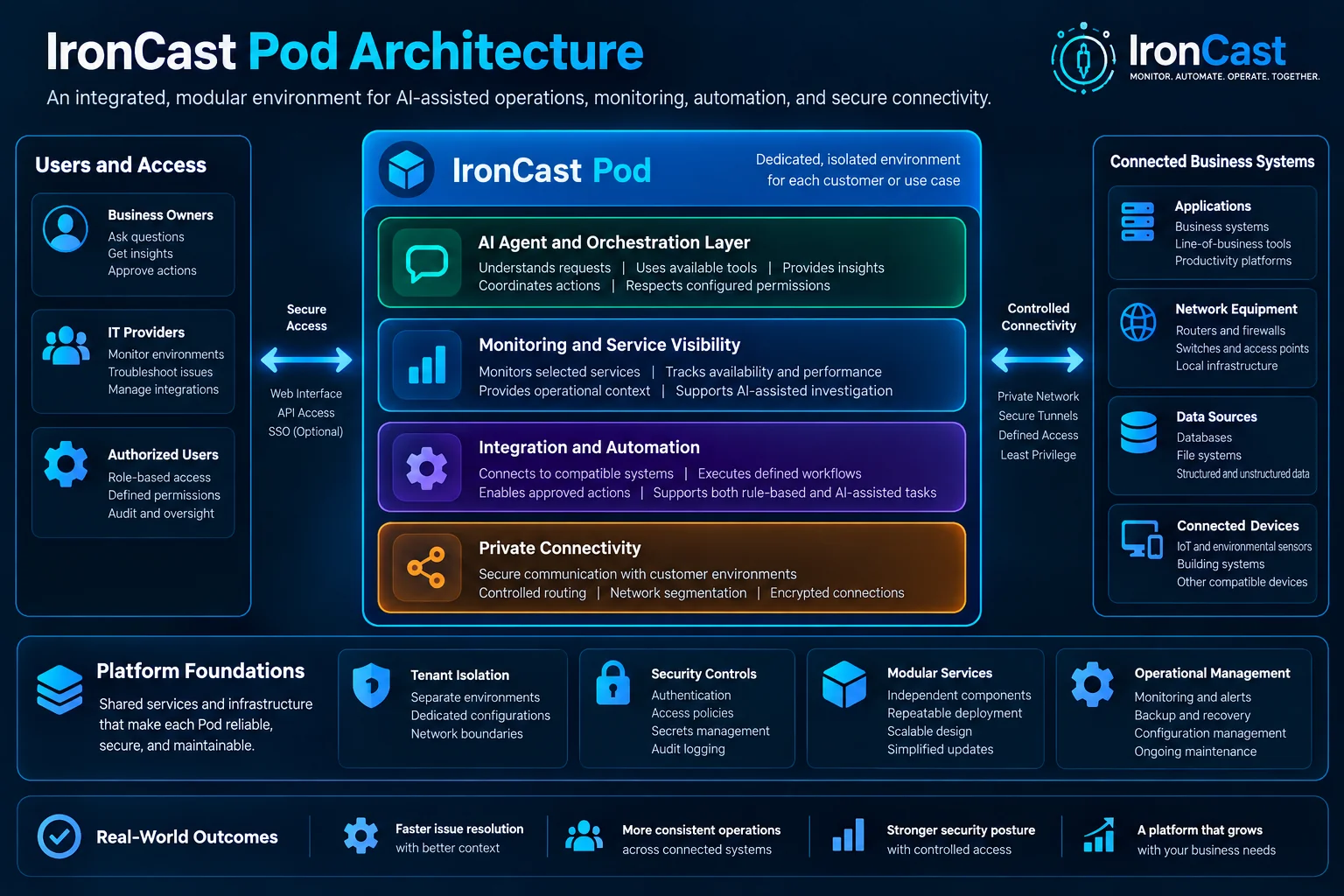
AI Agent and Orchestration Layer
The AI layer provides a way for users to interact with connected tools and information through an agent-based interface.
IronCast’s architecture separates the user-facing experience from the agent service responsible for coordinating requests and invoking available tools.
This allows the agent to retrieve information from connected services and, where explicitly enabled, request actions through defined integrations.
For example, an agent can be connected to a system-management service to retrieve operational information rather than relying solely on general language-model knowledge.
The distinction between generating a response and accessing live system data is fundamental. An agent should not be assumed to know the current state of an environment unless it has retrieved relevant information through an authorized integration.
Monitoring and Service Visibility
A monitoring layer provides visibility into the availability and health of selected services.
For many businesses, this is one of the most practical starting points. Knowing whether an important application or endpoint is responding can help identify issues earlier and provide useful context for troubleshooting.
Monitoring also creates opportunities for AI-assisted investigation. A connected agent may be able to retrieve status information, summarize observations, and help determine what deserves attention.
However, monitoring data has limits. An availability check does not necessarily explain the root cause of a failure, and a successful check does not guarantee that every business function is operating correctly.
Integration and Automation Capabilities
A Pod becomes more useful when it can interact with systems outside its own environment.
Integrations may connect the platform to compatible applications, infrastructure services, connected devices, or automation tools.
The objective is to make information and approved actions available through defined interfaces rather than requiring users to navigate unrelated systems manually.
Conventional automation remains important. Predictable, repeatable operations are often better implemented as predefined workflows, while AI can assist with interpreting information, choosing among permitted tools, or preparing summaries.
The engineering goal is coordination—not unrestricted autonomy.
Private Connectivity
Many useful integrations require access to systems that are not publicly accessible.
A customer may have network equipment, internal applications, or connected devices operating within a private business network.
IronCast incorporates private connectivity capabilities to support communication between authorized services and customer environments.
This approach can reduce the need to expose internal management interfaces directly to the public internet.
Connectivity alone does not establish trust, however. Appropriate access policies, endpoint security, and controls over which systems can communicate remain essential.
Why Tenant Isolation Matters
When a platform serves multiple customers, separation between their environments becomes a central architectural requirement.
IronCast uses individually organized tenant environments with dedicated service configurations and network boundaries.
The purpose is to reduce unintended interaction between customer workloads and establish clearer boundaries for connectivity, configuration, and operations.
Network segmentation is one part of that design. Service permissions, application authentication, secrets management, and administrative controls are also important.
Isolation should not be confused with a blanket security guarantee. Its effectiveness depends on the complete implementation, ongoing maintenance, and verification of the relevant controls.
For IronCast, tenant isolation is an engineering principle that must be tested—not merely described.
Connecting Cloud Services to Existing Business Technology
One of the more challenging aspects of an integrated platform is connecting hosted services with technology operating inside a customer’s location.
A business may want to monitor a local device, retrieve information from an internal application, or coordinate an authorized workflow without making that system publicly accessible.
The IronCast architecture addresses this through a combination of private networking, controlled routing, and service-level integrations.
This design allows the platform to establish communication paths where appropriate while maintaining separation between unrelated environments.
It also introduces practical engineering considerations:
- Which services actually require access to the customer’s private network?
- What destinations should those services be permitted to reach?
- How should connectivity behave when a remote connection becomes unavailable?
- Which capabilities can operate entirely within the hosted environment?
These questions are evaluated according to the purpose of each service rather than assuming every component requires the same network access.
Engineering for Modularity and Maintainability
A modular architecture helps keep responsibilities understandable.
An AI service can be updated or configured independently of a monitoring service. A customer environment can introduce an additional integration without necessarily replacing the entire platform.
This does not mean modular systems are free from complexity. Multiple services introduce dependencies, configuration requirements, upgrade considerations, and operational overhead.
IronCast’s design therefore emphasizes a practical balance between flexibility and maintainability.
Several principles guide that approach:
- Clear service responsibilities. Each component should have a defined purpose.
- Controlled communication. Services should receive the connectivity and permissions their functions require.
- Repeatable deployment. Standardized configurations help reduce differences between environments.
- Operational visibility. Important components should be monitored and their behavior understandable.
- Resource awareness. Additional capabilities should justify their computing, storage, and maintenance requirements.
For smaller organizations, operational simplicity can be just as important as feature availability.
What We’ve Validated in Development
IronCast’s Pod architecture has undergone integration testing across multiple service components.
Development validation has included an AI agent retrieving information through a connected service, invoking permitted execution tools, communicating with selected private-network resources, and accessing supporting platform services.
Monitoring checks and connectivity tests have also been used to assess whether essential components are reachable and functioning as expected.
These results demonstrate that the core integration approach is technically workable.
They do not mean that every customer integration has been tested, that every workflow is production-ready, or that the platform can automatically support any application or device.
Each customer deployment still requires appropriate configuration, compatibility assessment, and validation.
Tradeoffs Behind the Design
Engineering decisions rarely produce benefits without introducing responsibilities.
Integration versus complexity: Bringing services together creates new capabilities, but also requires coordination and maintenance.
Flexibility versus standardization: Customer environments differ, yet a consistent baseline makes deployments easier to support.
Connectivity versus security: Access to private systems enables useful workflows, but must be constrained to authorized purposes.
AI autonomy versus control: Agents can assist with multi-step tasks, but sensitive operations require defined permissions and appropriate oversight.
Capability versus resource consumption: Additional services can be useful, but they also consume infrastructure resources and increase support requirements.
The objective is not to maximize the number of installed tools. It is to build a platform whose capabilities are understandable, maintainable, and useful.
What This Means for Small Businesses
Most small businesses do not need to manage the underlying details of container networking, agent orchestration, or service routing.
They do, however, benefit when those engineering decisions produce a platform that can be configured around their needs.
A business might begin with monitoring important services or establishing controlled access to existing technology.
Later, it might introduce an AI-assisted information-retrieval workflow, a connected application, or an additional automation capability.
The modular approach is intended to support that progression without treating every new requirement as a complete technology replacement.
IronCast also offers a complimentary Pod opportunity for qualifying, verified small and medium-sized businesses, subject to eligibility, available resources, and applicable service limitations.
Building on a Practical Foundation
The IronCast Pod reflects a straightforward philosophy: advanced technology should be integrated deliberately, with clear responsibilities and appropriate controls.
AI agents are one part of that environment. Monitoring, automation, private connectivity, and the engineering foundations beneath them are equally important.
As the platform evolves, we’ll continue sharing meaningful technical developments, validated capabilities, and the decisions behind them.
A useful AI platform isn’t defined only by the intelligence of its model. It’s defined by how reliably and responsibly that intelligence can work with the technology around it.
Explore IronCast
Learn more about the IronCast Platform, explore our Applications, or review the complimentary Pod offering for qualifying businesses.
For related reading, see Introducing IronCast and How AI Agents Can Help Small Businesses Automate Everyday Operations.